STANLEY CABS
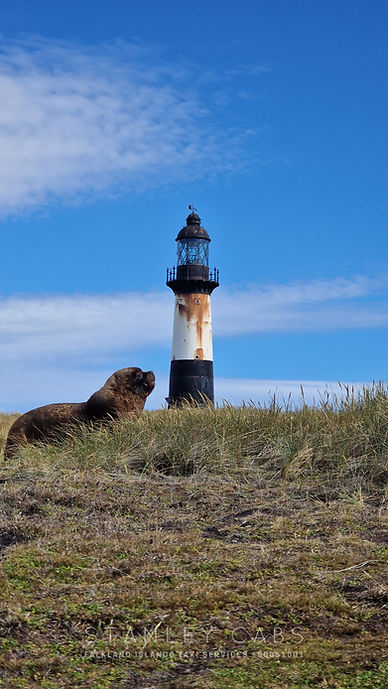
Cape Pembroke Lighthouse
Cape Pembroke – Wildlife, History & Coastal Scenery
The most easterly point of East Falkland, the Cape Pembroke peninsula is home to a variety of natural attractions, including Gypsy Cove, Yorke Bay, and, of course, the lighthouse.
Built in 1855, the Cape Pembroke Lighthouse is well known for its remote setting and abundant wildlife. The area offers scenic coastal views, small beaches, and quiet coves that are popular with locals. If you are fortunate, you may spot Peale’s or Commerson’s dolphins swimming offshore. Sea lions are frequently seen in the area, and occasionally a leopard seal may also be spotted.
If you encounter any wildlife, please remember to keep a respectful distance of at least five metres at all times.
A Lighthouse with a Story
The lighthouse was originally built in 1855 and included accommodation for the lighthouse keeper. Today, the remains of the original keeper’s house are difficult to distinguish.
It was constructed to mark the entrance to Stanley Harbour and was first painted in the traditional red and white stripes. In the early 1900s, cracks began to appear in the foundations, causing structural concerns. As a result, the original lighthouse was dismantled and re-erected in 1907. It was then repainted black with a broad white band — the appearance it retains today.
Following the 1982 conflict, the lighthouse was decommissioned. The local keeper at the time reportedly witnessed the first sightings of Argentine forces arriving in the Islands. After the war, the lighthouse was never returned to operation.
Also located beside the lighthouse is the Atlantic Conveyor Memorial, a striking and moving tribute, offering another important historical point of interest for visitors.
Visiting Cape Pembroke
Visitors can still access the top of the lighthouse if staying in the Islands for more than one day. Access is arranged through the Historic Dockyard Museum, located on Ross Road, where the key can be hired for a fee of £10.
The road to Cape Pembroke eventually becomes a gravel track with several potholes, so the drive can be slightly rough in places. The area is also well suited to exploring on foot.
Due to the uneven grassy terrain and occasional damp ground conditions, this location is unfortunately not considered wheelchair friendly.